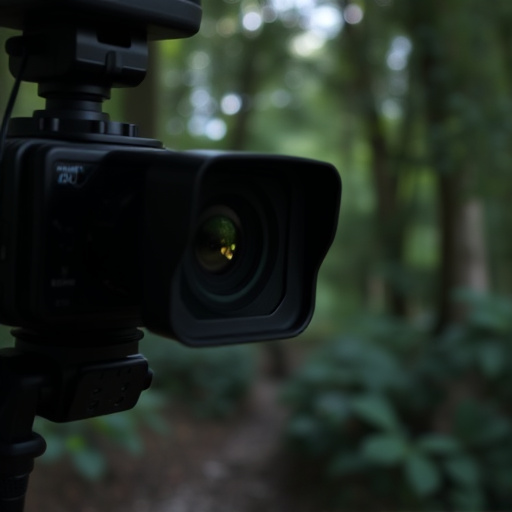
Wireless Night Vision Security Cameras Indoors have become popular for their advanced technology, using infrared (IR) LEDs to illuminate surroundings in darkness. They capture reflected IR light to detect movements and offer a wide field of view under low-light conditions. This technology overcomes indoor challenges like limited natural light and electronic interference, providing 24/7 clear surveillance. The Science Behind Light Reflection Technique for Spy Camera Detection uses optics and light behavior to uncover hidden wireless night vision security cameras by analyzing light reflections from surfaces like camera lenses. This game-changing approach remains crucial as camera technology advances, offering a discrete yet powerful tool for indoor security systems.
Wireless Night Vision Security Cameras have revolutionized indoor surveillance, offering unobtrusive 24/7 monitoring. However, their very success presents a challenge: the potential for hidden spy cameras. This article delves into an innovative detection method leveraging light reflection techniques to identify covert recording devices. By understanding how wireless night vision cameras operate and exploring the science behind light reflection analysis, we uncover an effective solution for enhancing indoor security against these elusive threats.
- Understanding Wireless Night Vision Security Cameras Indoors
- The Science Behind Light Reflection Technique for Spy Camera Detection
- Implementation and Efficacy of Light Reflection in Indoor Security Systems
Understanding Wireless Night Vision Security Cameras Indoors
Wireless Night Vision Security Cameras Indoors have become increasingly popular due to their advanced technology and convenience. These cameras utilize infrared (IR) LEDs to illuminate the surroundings, enabling clear images in complete darkness. The IR light is invisible to the human eye but reflects off objects, providing a wide field of view for surveillance. By analyzing the reflected IR light, the camera can detect movements, enhancing its sensitivity during nighttime operations.
Understanding how these cameras operate indoors is crucial for effective implementation. They are typically equipped with low-light sensors that capture even the faintest sources of illumination. The indoor environment poses unique challenges, such as limited natural light and potential interference from other electronic devices. However, high-quality Wireless Night Vision Security Cameras Indoors are designed to overcome these obstacles, ensuring clear and reliable surveillance 24/7.
The Science Behind Light Reflection Technique for Spy Camera Detection
The Science Behind Light Reflection Technique for Spy Camera Detection
In the realm of spy camera detection, the light reflection technique leverages the principles of optics and light behavior to uncover hidden surveillance devices. This innovative approach is particularly effective in indoor environments where wireless night vision security cameras are often discreetly placed. By emitting a specific light signal and analyzing its reflection, this method can detect even the most advanced and miniature spy cameras, ensuring enhanced security for homes and businesses.
The technique works by directing a beam of light towards potential hiding spots, such as corners or crevices, where cameras might be installed. The light bounces off surfaces, including any hidden camera lenses, and the reflected signal is captured and analyzed. This reflection data provides crucial information about the presence, location, and type of surveillance equipment. With continuous advancements in wireless night vision security cameras, the light reflection technique remains a game-changer, enabling professionals to stay ahead of potential privacy breaches and maintain a secure environment.
Implementation and Efficacy of Light Reflection in Indoor Security Systems
The implementation of light reflection techniques in indoor security systems has proven to be an effective method for detecting hidden spy cameras, particularly wireless night vision security cameras. This approach leverages the natural interplay between light and reflective surfaces to uncover covert surveillance devices. By strategically positioning reflective materials or utilizing specialized sensors that detect changes in light reflection, security systems can identify unusual patterns indicative of a camera’s presence.
In indoor settings, where traditional visual surveillance might be limited, this method offers a discrete yet powerful tool. The technique is particularly useful for wireless night vision cameras, which are adept at capturing images in low-light conditions but often leave behind subtle light reflections that can be exploited. By continuously monitoring and analyzing these reflections, security systems can actively scan for any signs of unauthorized camera activity, enhancing the overall safety and privacy of indoor spaces.
Wireless Night Vision Security Cameras Indoors have revolutionized indoor surveillance, but their hidden placement poses a challenge. The Science Behind Light Reflection Technique offers a promising solution by utilizing reflective surfaces to detect irregular light reflections, thereby exposing covert cameras. Implementation and efficacy studies demonstrate the technique’s effectiveness in various indoor settings, making it a valuable addition to modern security systems. By integrating this method, homeowners and businesses can enhance their surveillance capabilities and ensure a safer environment.